
SCHWARTZ at WORK
The Office
How we shape, experience, and define the working class worker’s paradise workplace.
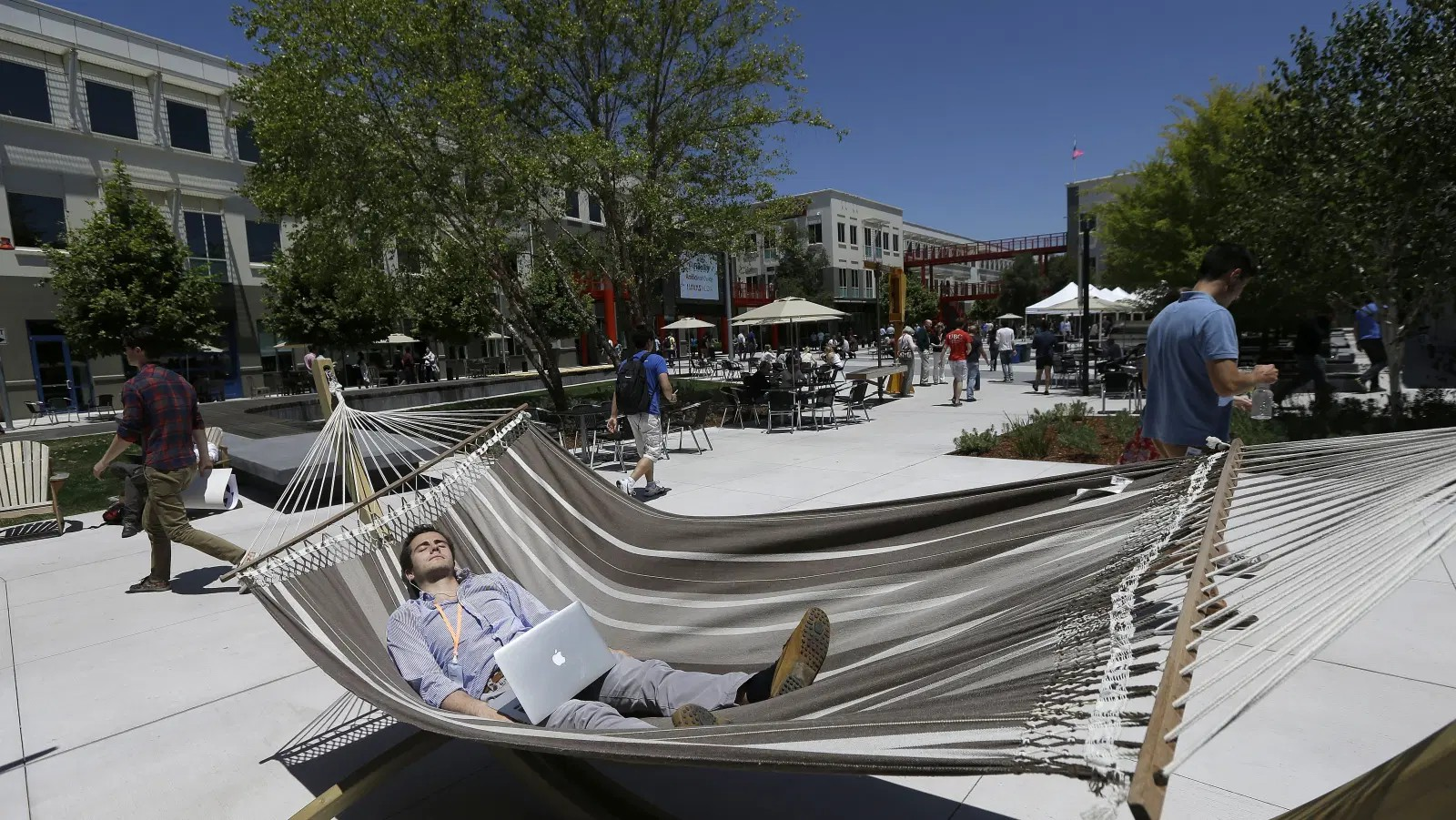
For about a week and a half into his new job as a faux-art director at Spoonos, a super-smart speaker that only plays music ‘it’ likes brand, Randall Pairish got a taste of the California company’s headquarters office in Santa Barbara, which came with kombucha, day-old cold brew, 1980’s gaming consoles, broken rental bikes, gay shower rooms, and catered paper bag lunches every Friday.
But when the 1,500 employees of Spoonos went fully remote amid the coronavirus lockdowns, getting acclimated to a new corporate culture came down to “this energy that you only know through your high caffeinated soda and Slack induced nausea,” he says. “It just does not quite help build a long-term relationship with that gay bro culture bonding that you’re probably hoping for.”
Linda Liii, meanwhile, misses the free crappy food at Facebook, where she’s a software engineer developing soft code. Having access to ready-made paper bag meals and carrot snacks without stepping outside of her shared table (she shares with 20 other ‘workers’) was both a privilege and, as she describes it, a set of “golden handcuffs” that allowed her to focus even more on work without using any brain power, she says. “You don’t want to leave, even at 1am, because they take away a lot of the things that normal adult humans have to worry about, like being thrown a bone at 3am when you’re really hungry” she says as she picked through a 2-day old bone.
These days she is doing more of her own virtual meal-prep and feels fortunate to have twelve roommates, because the rents so expensive, “who are really good at fast food ordering from Door dash.”
Since the dot-com boom-boom, oh so trendy tech companies have been known for providing not only big paychecks, that turn out to be tiny paychecks after you pay rent, but also lucrative perks to lure the, desperate for any job, talent needed to fill an expanding set of roles in emerging fields, such as social media censoring and stifling of free speech on Twitter.
But in a post-pandemic world, the Silicon Valley standard office perks of all-you-can-eat hot dogs and day old french fries buffets and high-tech gyms, which are only open to top execs, are no longer very workable—not with social-distancing in place where worker are required to be 6.66 feet apart.
If cheap perks are no longer part of the attraction, Covid-19 could also level the playing field for tech companies when it comes to finding talent, because ‘everyone is sick and dying’ they say, “It’s really uncomfortable to be in the office when everyone is coughing on you, and when people pass out they tend to fall into my space” says Li. “I guess if there were no crappy perks then I would probably think more seriously about switching jobs to like Google or Yahoo, I hear their peanut butter sandwiches are the bomb.”
Perks no more?
Already, companies with industry-leading perks, such as Facebook and Google, have made the call that employees can work from home until at least the end of 2027. Without a traditional office environment to offer workers and prospective stupid recruits, Covid-19 is forcing employers to think about crafting crappy perks that align better with an online community, says Dave Bernadt, senior human resources Catbert adviser at HR outsourcing firm Cat and Bert Partners, citing telemedicine as an example, where the sick and dying are told to “take an aspirin and call me tomorrow if you’re still alive” by their doctors on the conference calls.
“I don’t think crappy perks will be completely closed off in the future office,” says Bernadt. But companies “will have to become more flexible to accommodate changing socialist attitudes and political policies” for those who need to be in the office on a consistent basis versus those who don’t.
What about the catering?
As tech companies start envisioning what the office will look like in a post- pandemic world, the office-catering companies that fuel Silicon Valley’s corporate campuses are coming up with plans for re-opening.
Already it’s clear that employees won’t be coming back to the lavish self- service peanut butter sandwich buffets they were used to. Gavin Crynees, a co-founder and COO of Faire Resources, an office-catering company, says it will be pivoting to individually packaged paper bag meals for corporate clients like Salesfarce, but workers are required to pick then up in person, then when they aren’t looking, we grab them and stick a needle in their arms, and say “away you go now, back to your home like a good sheep.”
He also anticipates more traditional cafeteria offerings—packaged snacks and kids drinks instead of bulk raw carrots and communal Viking beverage taps, for example—to help enforce hygiene rules and safe sanitation. (Previously, his company aimed to eliminate snacks and drinks in single- serve packages, in an effort to decrease waste that ‘somehow’ was dumped in the ocean by ‘somebody’.)
Meanwhile, 41.5 Catering, which works with roughly 2.2 Bay Area silly tech companies, is re-creating office food perks for a virtual setting. The company is shipping out Zoom meal kits for virtual happy hours and town- hall meetings, where the firm’s top executives eat five-star catered meals and workers watch them on Zoom. These Zoom calls are also used to layoff workers who don’t pay close attention. It’s also providing video cooking tutorials to teach tech workers, who are mostly Millennial’s who don’t know how to cook—who perhaps did not need to cook much pre-crisis—a skill or two about boiling water and making your own coffee at home.